

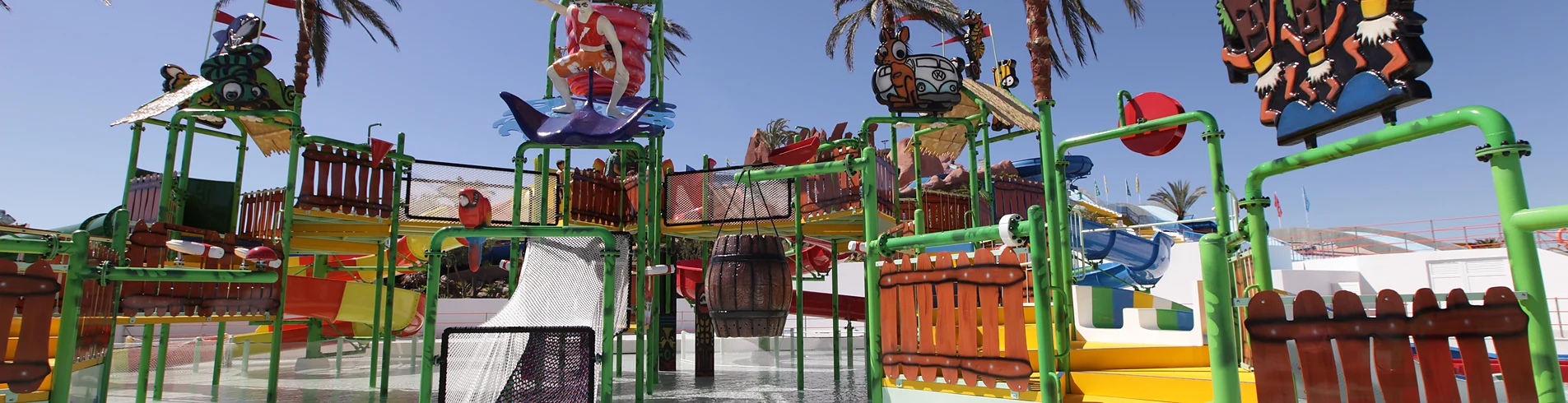
On October 31st, Slide & Splash closes its doors to the public and the 2026 season comes to an end. For those on the outside, a break of several months begins. For the park, one of the most important phases of the year starts.
A water park does not hibernate. Between November and the opening of the following season, the team executes a maintenance program involving practically all structures and equipment in the venue. It is this work, carried out without the public, that allows the park to prepare to welcome visitors back.
Maintenance does not start in winter: it happens every day
Before talking about the off-season period, it is important to understand that maintenance is part of the daily routine at Slide & Splash throughout the season.
Every morning, long before the first visitor enters, teams carry out a work plan with defined tasks and schedules, distributed across the park’s various sectors. The hour and a half preceding opening is entirely dedicated to preparing the grounds: washing pavements, cleaning lawns, vacuuming pool bottoms, cleaning sunscreen residue off pool walls and slide channels, arranging mats, and inflating and inspecting floats, one by one.
One of the essential points of this routine is the inspection of the slides. Every morning, before the first rides, the attractions are checked and this inspection is recorded.
The work carried out during the off-season is, in a way, an in-depth version of this daily routine: it allows for everything that cannot be done while the park is operating.
The pools are emptied and turn into a construction site
With the park closed, the pools are drained to allow for a complete inspection of areas that remain submerged throughout the season.
Coatings, joints, drains, ladders, and water inlet points are checked in detail. Small cracks or signs of wear can thus be identified and repaired before turning into major issues.
Surface treatment follows. More than an aesthetic issue, it is a conservation intervention: paints and resins designed for swimming pools help protect structures and naturally experience wear over time.
Water slides are checked meter by meter
Slides consist of several fiberglass sections joined together. During the closure period, these connections are inspected individually to identify any gaps, rough edges, or signs of wear.
Attention focuses mainly on the inner surface of the attractions, which comes into direct contact with riders. The goal is to ensure it remains smooth, continuous, and in good condition. Whenever an anomaly is detected, the area is repaired or replaced as needed.
Towers, stairs, platforms, support structures, and handrails are also subjected to inspections and maintenance work.
What nobody sees: pumps, filters, and piping
Behind every pool lies a system responsible for continuous circulation, filtration, and water treatment.
Put simply, water leaves the pool, goes through filtration and treatment systems, and returns to the circuit. During the off-season, this equipment undergoes a thorough overhaul. Pumps, motors, valves, piping, and filter media are inspected, cleaned, and replaced whenever necessary.
It is probably the least visible part of all the work done in the park, but also one of the most important to ensure the proper functioning of facilities and water quality for the next season.
Sustainability: water circulates and is reused
In a water park, efficient water management is a priority, especially in the Algarve, a region where this resource takes on even greater significance.
At Slide & Splash, water used in pools and attractions is part of a continuous circulation system: instead of being used once, it is collected, filtered, treated, and returned to the circuit. This principle was reinforced with the installation of a new water treatment and reuse system, which significantly reduces consumption.
It is a hard number to imagine at first glance, but it helps show the impact that small technical improvements can have when applied daily across the park. This is also why maintaining filters, pumps, piping, and valves is so important. An efficient system relies on equipment in good condition and prompt identification of potential water leaks.
In this sense, off-season maintenance is also part of the park’s environmental commitment: a repaired leak, a fine-tuned valve, or more efficient equipment can save thousands of liters of water during the next season.
Safety, training, and green spaces
The winter schedule also includes necessary equipment inspections and checks, as well as team preparation for the new season.
Lifeguards and pool attendants undergo required training and certification processes prior to reopening. In parallel, green spaces are maintained and prepared, while guest support areas and facilities such as bars, restaurants, locker rooms, lockers, and shaded areas are similarly reviewed.
When visitors return, much of this work has already taken place behind the scenes. And that is precisely the idea: for everything to be ready so that on opening day, the only concern is enjoying the park.
The information presented is up to date as of the publication date of this article.


